
26 October 2026
Sayyid Badr Albusaidi, Foreign Minister of the Sultanate of Oman has called on Gulf states to take collective responsibility for their own security through an inclusive regional framework.
He said this framework must bring together all six Gulf Cooperation Council states, alongside Iran and Iraq.
Iran’s exclusion from regional security arrangements, he said, had carried profoundly negative consequences for the region as a whole.
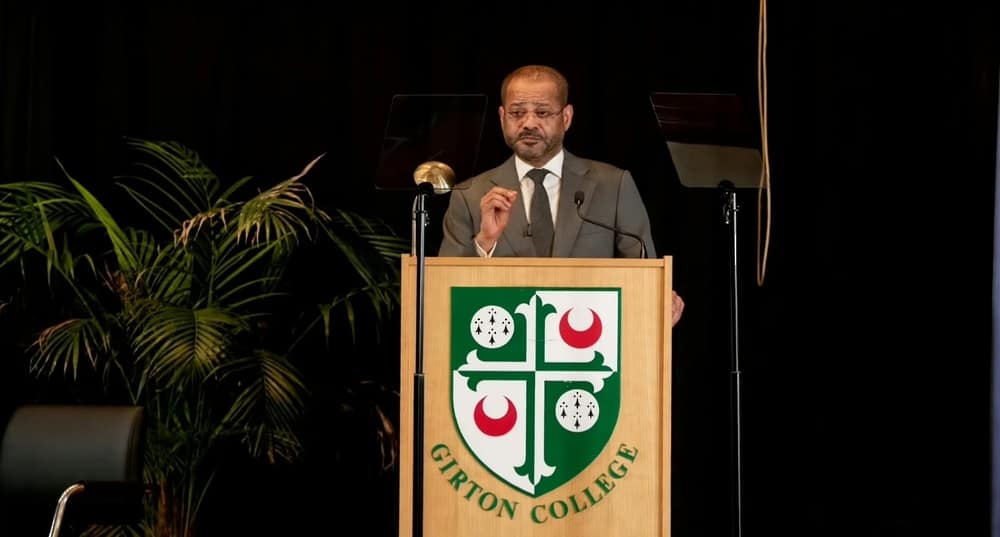
In a lecture entitled “Inclusive Security in the Gulf” delivered at Girton College, at the University of Cambridge in the UK, to an audience of more than 100 diplomats and foreign policy specialists, the Minister began by speaking of the positive outcomes of His Majesty Sultan Haitham bin Tarik’s State visit to the UK at the invitation of His Royal Highness King Charles III
“We are grateful, to the King, he said, “for recognising in his State Banquet address Oman’s ‘constructive neutrality’ and its ‘noble efforts’ as a trusted interlocutor in supporting free navigation through the Strait of Hormuz.”
The Minister went on to call for a new regional dialogue among the Gulf States, with a non-aggression pact between all eight states as its central goal.
He described such a pact as an essential prerequisite for a security framework that could build trust, address shared challenges and support lasting stability.
The Minister said the security of Oman depends on the security of its neighbours. This understanding guides Oman’s efforts to resolve conflicts, strengthen confidence and extend peace across the region.
He argued that longstanding reliance on external powers had limited the Gulf states’ ability to develop collective arrangements rooted in their own needs.
External interests had also complicated efforts to resolve differences concerning Iran’s nuclear programme and secure free navigation through the Strait of Hormuz.
The Minister rejected the idea of a fundamental antagonism between Iran and the Arab states of the Gulf, pointing to centuries of peaceful coexistence between Arabs and Persians.
“It’s not a matter of whether you’re friendly or hostile to Iran,” he said. “Any Gulf security architecture that doesn’t include them is inherently unstable,” he added.
Recalling the November 1976 meeting in Muscat of the Foreign Ministers of all eight Gulf states, he called for its ambition of collective regional security to be renewed.
“The meeting can be reconvened,” he said, calling for an ambitious agenda that would include a shared understanding of arrangements for maritime traffic through the Strait of Hormuz.
The Minister said external partnerships should continue, while regional states assume primary responsibility for their security.
He said it was not necessary to convince friends and allies beyond the region about the need for the Gulf states to take responsibility for devising, developing and implementing a new regional security structure.
“It would be useful… but it’s not essential,” he explained, adding:
“The point is that the solution doesn’t depend on friends and allies beyond the region.”
He expressed hope that partnerships with countries outside the region would increasingly focus on economic cooperation and investment across all eight countries.
Acknowledging longstanding and recent causes of mistrust, he said the difficulties should not delay the first steps towards dialogue.
He concluded by speaking of a “growing shared recognition” that a future security framework for the Gulf will have to involve all eight states of the Gulf and that such a framework can no longer rely on the cooperation of external partners.
“This does not mean that external partnerships should be abandoned. It is just that their role in the regional security architecture can no longer be primary,” he added.
“If the Gulf steps up, inclusive regional security – the vision of 1976 – can be achieved,” he said.
To view the full text of the lecture click here.
This is an unofficial English version of an Arabic report. To view the official Arabic text, click here.
Related stories: