
26 October 2026
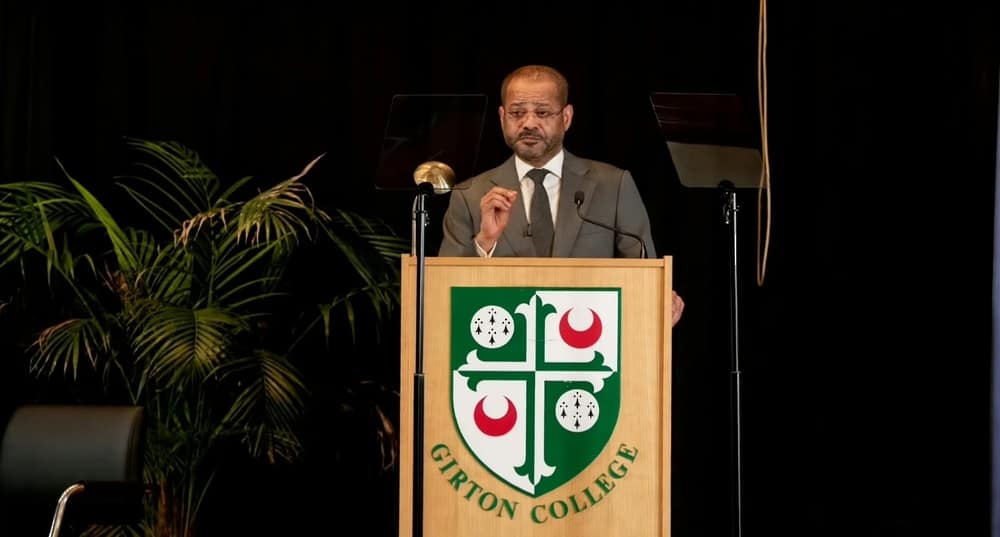
The following is the text of a lecture delivered by Sayyid Badr Albusaidi, Foreign Minister of the Sultanate of Oman, at Girton College at Cambridge University in the UK.
The title of the lecture was “Inclusive Security in the Gulf”.
“I am honoured to have this opportunity to speak here at Girton College this evening.
“I am particularly delighted to do so, not only at the invitation of a scholar who has made such an outstanding contribution in understanding the history and contemporary realities of Arab society and culture, but also at a College whose commitment to the highest possible academic achievement for women has been of truly historic significance.
“So I thank you most warmly, dear Elisabeth [Dr Elisabeth Kendall , Mistress of Girton College], for hosting me.
“And I thank you all for coming to hear what I have to say.
“It is both a privilege and a challenge to share some thoughts drawn from a life largely devoted to diplomacy.
“Before I do so, I wish to note the great kindness of Their Majesties King Charles and Queen Camilla at Windsor Castle, in so graciously hosting His Majesty the Sultan of Oman and his delegation for a state visit to the United Kingdom last week.
“The visit reaffirmed the exceptional longevity and depth of a relationship whose formal origins date to the 1798 Treaty of Friendship and a commercial agreement made with the British East India Company in 1647.
“The visit enabled substantive diplomatic and economic engagement at a time of acute regional tension.
“We are grateful to the King for recognising in his State Banquet address Oman’s “constructive neutrality” and its “noble efforts” as a trusted interlocutor in supporting free navigation through the Strait of Hormuz, underscoring Oman’s continuing geopolitical role and its value to British and wider international interests.
“Parallel talks with Prime Minister Burnham yielded concrete results, including expanded sovereign investment cooperation, a major AI data-centre project, increased UK Export Finance capacity for British exports to Oman, and strengthened maritime security coordination.
“In both its symbolic and practical dimensions, the visit illustrated how a historically grounded partnership continues to adapt to contemporary priorities, linking dynastic continuity and shared strategic interests with tangible and practical commitments.
“This evening I would like to talk about the security of the region in which I live – the Gulf.
“Arabian or Persian? The name is contested, but its strategic importance is not. You will understand why this matters.
“The events of the last two years mean that few think of the security of the Gulf without more or less immediately thinking about its insecurity.
“About states with longstanding tensions and antagonisms. About a global waterway, acutely vulnerable to disruption.
“About a long history of armed conflict, from the Iraq Iran war in the 1980s, to the liberation of Kuwait from Iraqi occupation in 1991, to the recent war waged on Iran by Israel and the United States.
“Today, the Gulf is a region whose instability is viewed by many as the gravest threat to wider global security, as well as a place where lives and livelihoods are at risk of disruption and destruction.
“My country Oman is not immune to this regional insecurity.
“Yes, Oman enjoys peaceful relations with all its neighbours. Our daily life is calm: some like to think of Oman as an oasis of peace in a region divided by conflict.
“But this is not the whole picture.
“Oman recognises the reality that its security depends upon the security of its neighbours.
“This motivates our efforts to engage with our neighbours to resolve conflicts, build trust and to preserve and extend the peace we enjoy.
“It is widely known that Oman has been involved in two phases of critical negotiations in the Gulf over the last two years, in which, of course, the security of the region has been very much at stake.
“The first was the series of indirect talks, facilitated by Oman in Muscat, Rome and Geneva, five sessions in April and May 2025, and three sessions in February of this year.
“In these talks Iran and the United States sought to resolve their differences over Iran’s nuclear programme, and end 47 years of mutual hostility.
“The second phase began after the conclusion of the Memorandum of Understanding on June 17th, between Iran and the United States, which paused the armed conflict, which had begun on February 28.
“This was at a time, let us not forget, when the talks on the nuclear issue were still under way.
“This second set of negotiations, conducted within the framework of the Memorandum of Understanding, was between Oman and Iran, and sought to reach agreement on arrangements to help secure free navigation through the Strait of Hormuz.
“Oman believed that the first series of negotiations, between Iran and the United States, was making significant progress, and that an agreement was within reach.
“We still stand by that judgement today.
“The basic components for such an agreement still exist, should both parties decide to return to these negotiations. But needless to say the path back to the negotiating table, in what is hopefully the aftermath of the war, is now very difficult for both the United States and Iran.
“It was envisaged that a key stage along the path to renewed negotiations would be an agreement on the resumption of free navigation through the Strait of Hormuz. High level discussions and technical consultations between Oman and Iran have resulted in the outline of a temporary arrangement. But even this faces political obstacles.
“Put simply, it is hard to see how any such arrangement can be implemented unless both Iran and the United States are willing to compromise and reach a pragmatic understanding that will include reversing some actions taken during the recent war, which have largely led to the suspension of maritime traffic.
“Much has been said and written about both of these processes, and I don’t wish to add to what’s already in the public domain.
“What I would prefer to do is to talk about what can be learned from the experience of these two as yet incomplete processes of negotiation about the prospects for meaningful regional security in the Gulf.
“The key lesson to be learned and reflected on is this.
“What holds us back is that issues which ought to be handled at a regional level by the states of the Gulf themselves, are made more complex, more intractable and sometimes simply impossible to resolve because the region’s security arrangements are insufficiently developed.
“And they are insufficiently developed because they have relied for too long on the involvement of external powers.
“The complications which stand in the way of successful resolutions to both the Iranian nuclear issue and the question of free navigation through the Strait of Hormuz are simply the latest effects of an unstable combination of power projection and dependency in the Gulf.
“In other words, the nuclear issue and the Hormuz issue are both impossible to resolve because external powers continue to define the terms of engagement, while regional powers are unable to take collective responsibility for making their own security arrangements and reach a consensus on them.
“That is why in my talk today I am making a call for us in the Gulf to step up and take responsibility for our own security, and for us to do so inclusively. By including, as a matter of principle and practice, all the states of the Gulf.
“All six Gulf Cooperation Council states. And Iraq.
“And, crucially, Iran, which has for nearly half a century been systematically excluded from playing any meaningful role in the security arrangements of the region. An exclusion with profoundly negative consequences, not just for Iran, but for the region as a whole.
“A few historical observations may help explain how this happened and why it has been so damaging.
“There’s a long history of people devising security plans, not just in the Gulf, but across the wider Middle East and West Asia region.
“Such arrangements run from Sykes-Picot, which after the First World War carved up the Arab territories of the Ottoman Empire, to the Gaza Board of Peace in which Palestinians barely have any role in shaping the terms under which it is proposed they should live and be governed.
“Regional powers, initially left out of such plans, or included within them as junior partners, have subsequently been unable to provide alternatives to a series of colonial or Cold War arrangements, which have long outlived their value and are no longer fit for purpose.
“Unable, that is, to develop coherent cooperative approaches rooted in the needs of the region itself.
“Instead they have preferred the seemingly easier path of allowing others to provide.
“Friends and allies from outside the region have offered both material and political support for Gulf security – not freely of course, but at a significant financial cost.
“From treaties, agreements and intelligence cooperation, to naval fleets, air defence systems and troops on the ground. With these substantial commitments, have come political priorities and national interests that have not always served the common interests of the region, its states and its people.
“This path may have had a compelling logic when it was initially taken. After all why not allow those with superpower levels of military resource to do your security for you, especially if you can afford to pay?
“But its long-term political cost has been too high.
“Perhaps the most damaging of the priorities imposed on the region from the outside has been the requirement that Iran be excluded.
“Not just excluded. Worse.
“Positioned as the threat against which regional security had to be organised.
“Instead of a genuine security structure designed to maintain stable relations between the eight states of the Gulf, this produced an unstable regional system constructed on the entirely false perception that there is a fundamental regional antagonism between Iran and the Arab states of the Gulf.
“There is no such fundamental antagonism.
“There are problems, yes. But the plain fact is that Arabs and Persians have lived in peace around the Gulf for centuries.
“It’s not a matter of whether you’re friendly or hostile to Iran.
“Today, Persia is a fact, 93 million people and three thousand years of history. Roughly half of the Gulf littoral.
“Any Gulf security architecture that doesn’t include them is inherently unstable. It’s structurally unsound.
“And recent events expose the terrible cost of allowing the false perception of antagonism and exclusion.
“Let me be clear.
“It is not even necessary to convince friends and allies beyond the region about this.
“It would be useful, of course, and so it is worthwhile continuing to try to persuade them that Iran is not inevitably an enemy or a threat to regional security.
“But it’s not essential. Because the point is that the solution doesn’t depend on friends and allies beyond the region.
“It is us, in the Gulf, who ultimately bear the responsibility for devising, developing and implementing a new regional security structure.
The time has come when it no longer makes sense just to blame everyone else.
“We need to begin a new regional dialogue on Gulf security, and we need to do so before other solutions are imposed on the region which would effectively consolidate the pattern of dependency and exclusion for which we urgently need to find an alternative.
“What is needed, instead, is a new and inclusive framework, involving, as I have said, all eight Gulf littoral states.
“Fifty years ago, almost to the day, the foreign ministers of Bahrain, Iran, Iraq, Kuwait, Oman, Qatar, Saudi Arabia and the United Arab Emirates met for a summit in Muscat.
“The purpose of their meeting in November 1976 was to work towards the establishment of a collective security arrangement for the Gulf.
“The United Kingdom had withdrawn its forces from east of Suez and the region’s leaders recognised that there was both a requirement and an opportunity to organise for themselves a structure that would guarantee the security and stability of all, including, of course, a number of states which had only been formally established just a few years earlier.
“Regrettably, that was the first and last time that all eight Gulf states have met together, all around one table.
“So how was this opportunity missed? Why was the promise of Muscat in 1976 never fulfilled?
“The Iranian Revolution of 1979 and the Soviet invasion of Afghanistan in 1980, and also the Iraq Iran war through the 80s, changed the dynamics of the region.
“These major events encouraged both regional and global powers to neglect the path towards collective regional security, in favour of defensive reactions, which, while legitimate and even necessary at the time, have since hardened into an exclusionary structure that prevents genuine regional cooperation.
“The Carter Doctrine of 1980 established that the security of the Gulf would be regarded as a vital national interest for the United States. And over the decades the United States intensified its involvement and security cooperation in the region, from the establishment of CENTCOM in 1983, to the deployment of troops on the ground in support of the liberation of Kuwait in 1990. This was followed by the re-establishment of the 5th Fleet in Manama in 1995, and after 9/11 by the US base in Qatar.
“Oman was the first to participate in this form of security cooperation, concluding an access agreement with the United States in 1980.
“The agreement simply provides for U.S. military access in the event of need, and only by mutual consent. It was primarily in response to the Soviet invasion of Afghanistan. Over the decades we have recognised its significant achievements, even as its more recent drawbacks and limitations have become clear.
“The formation of the Gulf Cooperation Council in 1981, although by no means intended as a military or security organisation, achieved real and meaningful regional cooperation across many areas of shared life, and became a cornerstone of our economic development.But it also had the unanticipated and unintentional effect, over time, of consolidating a political geography which unfortunately fostered mutual suspicion.
“These reactions, and the structures they have bequeathed us, fifty years after the first attempt to establish a truly regional security cooperation, were of their historical moment. They addressed challenges which have since changed, evolved and now take very different forms.
“It is not too much, now, to ask ourselves: do the challenges of the present historical moment require a different approach?
“It is of course not possible to go back in time to Muscat 1976, when the opportunity for an inclusive regional security arrangement for the Gulf was real enough to warrant a summit.
“But it is still possible to recapture the ambition of that moment. The meeting can be reconvened. The agenda can and should be ambitious.
“There are complex and pressing issues to be addressed, including of course the development of a shared understanding of arrangements for maritime traffic through the Strait of Hormuz.
“But vital though these issues are, there should be a bolder overarching objective, towards which all eight states can focus their deliberations.
“A Non-Aggression Pact between all eight states should be the goal.
This is the essential pre-requisite for a genuinely inclusive regional security architecture. It will not be easy to achieve.
“There are both longstanding and very recent causes for doubt, suspicion and mutual uncertainty.
“But there is a growing shared recognition of two crucial realities:
o That the way forward will have to involve all eight states of the Gulf,
o And that it can no longer rely upon the cooperation of external partners.
“This does not mean that external partnerships should be abandoned. It is just that their role in the regional security architecture can no longer be primary.
“The hope is that, over time, external partnerships will less take the form of military commitments and start to look more like economic cooperation and investment in the future of the Gulf and in economic partnership with it.
“The whole Gulf. All eight countries.
“This aspiration was part of what was at stake in the talks between Iran and the United States.
In other words, it’s not a new or unexpected idea, but something I explored with both Iran and the United States for many hours.
“In a post war context there is a huge economic opportunity, not least for the United States, as well as for the countries of the region themselves.
“The details will be difficult. The conversations will be hard and long. But the direction to be taken is clear and the first steps must be taken now.
“If the Gulf steps up, inclusive regional security – the vision of 1976 – can be achieved.
“To work towards such an objective in the current climate may seem counter intuitive. But in fact it is the only rational course of action.
“I welcome the new ideas and the thinking, evolving among my colleagues in the Gulf. And I look forward to continuing the conversation for the benefit of all of us.
“Thank you.”
This is an unofficial English version of an Arabic report. To view the official Arabic text, click here.
Related stories: